An Israeli Object: A Matter of Time
Sophia Dekel
“Take, for instance, Robert Rauschenberg, the young American who was awarded the Grand Prize for painting at the Venice Biennale. What does he paint? Coca-Cola bottles. A symbol of the habitual, of the American way of life. And I accept it as art in his case; I agree with him. […] But here in Israel, a Coke bottle does not have the same status, the same significance. Those who want to be abreast of the times here must seek symbols of our own. Had someone taken medallions issued locally for publicity purposes, instruction brochures such as ‘Come to Israel,’ and other such senseless items, and assembled them into a large-scale collage, into a jumble encompassing this entire mess, including Rachel’s Tomb, etc., I would say that this is a local equivalent to the Coca-Cola bottle. Incidentally, it is only a matter of time before someone is going to do that here. Then we will be able to be free about things for which we are now forced to have mixed feelings.”
Yitzhak Danziger1
The exhibition An Israeli Object: A Matter of Time sets out to present objects, installations, video pieces and architectural models that represent identity in an attempt to pinpoint a local formal code – with all the similarities, differences and controversies entailed. It does not purport to represent all the fields of visual art in Israel, but rather to touch upon its subject matter through a multi-disciplinary dialogue among artists, designers and architects. The discussion will revolve around the discourse pertaining to Israeli identity and the interrelations between that identity and the local visual creation. In some respects, this is the completion of a cycle that began at the Bezalel School of Arts and Crafts (1906-1926) founded by Boris Schatz in Jerusalem in order to bring together East and West as well as past and present, in the spirit of the Arts and Crafts Movement,2 and continued with the sweeping pioneering process spurred by the members of the Second and Third Aliya (immigration waves), who endeavored to create a Hebrew Culture and model the “Hebrew Individual,” a “Jew of the Land of Israel, that is, a non-Diaspora Jew,”3 in keeping with the “negation of exile” that was at the very core of the Zionist ethos. (text taken from the catalogue)
The production of the exhibition and catalogue have been made
possible through the generous support of:
The Jerusalem Foundation
The Ministry of Science, Culture and Sports – The Department of Plastic Arts
The Jerusalem Municipality, Department of Culture
Exhibition curator & catalogue editor: Sophia Dekel
The Artists’ House:
Exhibition concept: Alexander Okun
Committee members: Chairman – Alexander Okun, Malka Eyal,
Yemima Ergas, Haim Ben-Shitrit, Israel Rabinovitz, Reut Shahar, Asaf Romano
Director: Ruth Malul Zadka
Staff: Shosh Averbukh, Shulamith Efrat, Shari Aharon
Public Relations: Rivka Shraga
Catalogue design and production: Studio Shimon Schneider
Photographs: Avraham Hay (unless specified otherwise)
Editing of essays by Sophia Dekel: Daphna Raz
Translation of essays by Sophia Dekel: Daria Kassovsky
Editing of article by Alexander Okun: Yossefa Even-Shoshan
English Translation: Timna Seligman
Colour separations, plates and press: Art Plus Ltd., Jerusalem
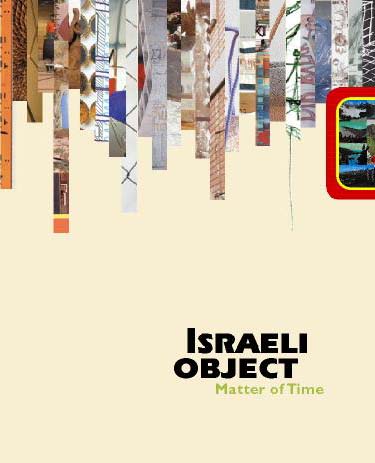
On the cover: a selection of works from the exhibition
Measurements are given in centimeters, height x width x depth
Thanks to: Milo Refrigeration Ltd., Lehem Erez, Mona Bar and Food,
Keter Plastic, Ackerstein Ltd., Palgit Ltd., Modi Ltd., J. Jacobi, Y. Harel,
Saxon, Art Plus Ltd., Avraham Hay, Shimon Schneider
In conjuction with:
The exhibition will be on display at the museum from 27.2.03
© All rights reserved to the Artists’ House, Jerusalem, December 2002
The Artists:
Noam Rabinovich
Israel Rabinovitz
Tal Amitai
Yael Moriah
Sigal Barnir
Anat Even
Marilou Levin
Ezri Tarazi
Ilana and Hans Pallada
Orit Siman Tov, Doron Pinchas
Rivka Potchebutzky
Boris Lecar
Reut Ferster
Eri Goshen
Shai Barkan
Gideon Gechtman
Dina Shoham, Hanna Parah
Meirav Davish Ben Moshe
Shlomo Vazana
Rachel Cohen Kedar
Erez Komarovski
Gilad Ophir, Rivka Potchebutzky
Adam Berg
Hagar Goren
Belu-Simion Fainaro, Avital Bar-Shay
Chanan de Lange
Hanan Pomagrin, Brad Pinchuk, Boubi Luxembourg
Joseph Dadoune
Nekoda and Dana Singer
Eliahou Eric Bokobza
David Guggenheim, Yoav Molcho
Raviv Lifshitz
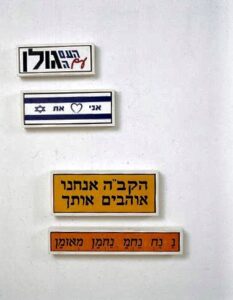
Tal Amitai
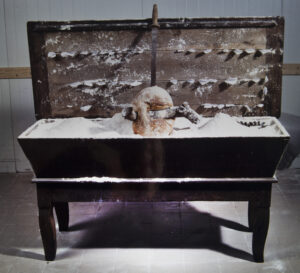
Erez Komarovski
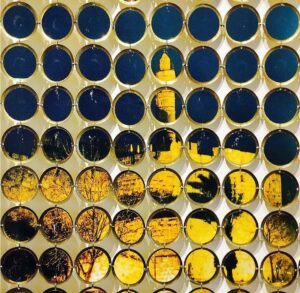
Reut Ferster