Symbols for Sale
Curator: Sophia Dekel-Caspi
For Sale, Symbols of State and Heritage (Luft Gesheft)
The exhibition Symbols for Sale was born from reality. Nelly Aman, a unique gallerist, wished to consult with me on a central work by gallery artist, Reut Ferster. The work, Jerusalem of Gold (2002), was created especially for an exhibition I curated for the Jerusalem Artists House, Israeli Object: A Matter of Time. The conversation drifted to the place of symbols in our lives and the need for visual images. Such images were designed to fill the emotional void of transforming pagan society to monotheistic abstraction, and were later on appropriated by interested entities. In the gap between multiple sacred images and minimized abstraction, man is in search of symbols anchored in religious, economic, communal or political contexts, as concrete images supporting beliefs and values.
The symbol, an attribute locating its subject in a hierarchy of belonging, is well-known in art history. In the past, artists acted as agents of either religious or secular institutions in order to enhance it. Only few dared, in the margins, to undermine the regime. Nowadays, however, many artists undermine the existing order and examine critically the roles of symbols in society, in the spirit of deconstruction denying the Metaphysics of Presence. The power relations between a symbol and its object transgress the mythical heritage of their past and are often under the stress of economic, political and other interests. Like a word in the visual vocabulary, the current symbol crosses the boundaries of material, technique and style and does not acknowledge territories of religion, nation, and economy.
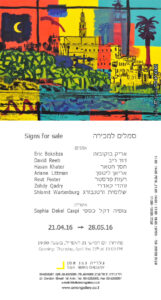
The exhibition Symbols for Sale, assembled in the intimate space of the Nelly Aman Gallery, includes works of artists creating in traditional as well as innovative media and materials – oil and acrylic paintings, alongside readymade and reproduction, papier-mâché, and embroidery – and using and challenging symbols of state and heritage. Some focus on an object, and others deal with the outlines of historically-charged cities, such as Jaffa, that symbolized a portal into Israel, or Jerusalem as a sacred center for all religions. The silhouette of Al-Aqsa Mosque is situated in front of the Tower of David, not far from the protruding cross above a cathedral, using ideological and stylistic means reminiscent of Dadaism and Pop Art, which were both subversive in their own way: one wished to demolish everything old for the principally new, while the other wallowed in daily reality in order to draw attention to the present and to the vast space occupied by the well-oiled advertising system. Today, once again we stand in a moral crossroad forcing us to reexamine bankrupt cultural images, and the exhibition wishes to promote discussion of these issues at our heart.
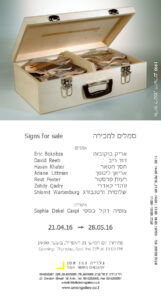
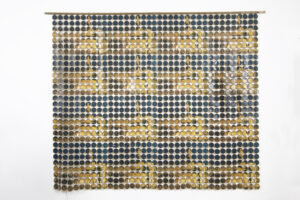
A Sisyphean process of cutting, dismantling, and assembling repeatedly allows Reut Ferster to distance herself from the postcard promoting tourism in Israel and from the icon impressed upon it, Jerusalem of Gold. Ferster performs this repetitive action in a new work, Outlet, created for this exhibition – gift bags like those handed out in birthday parties, with familiar items close to the heart. The process of dismantling and assembling enhances the absurdity of the image and its objectification as a concrete flicker of hope.
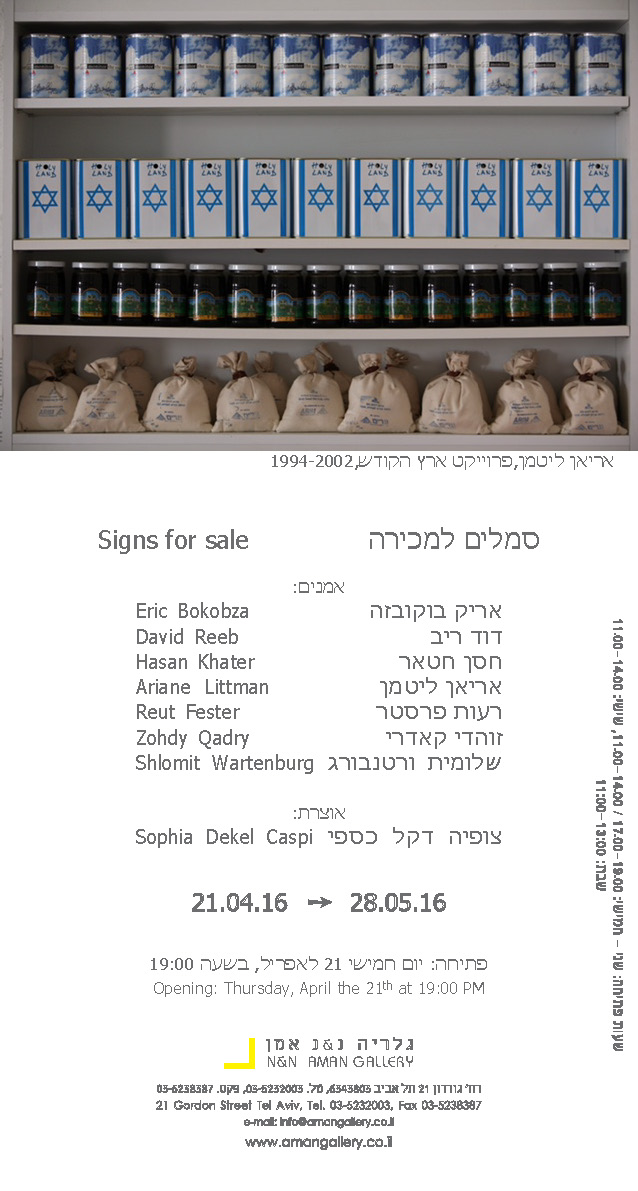
Ariane Littman started working with state and heritage symbols in the early 1990s, first with “sacred air” from the Holy Land as a slogan promoting religious-pilgrimage tourism, and later on with honey jars, water bottles and a jigsaw puzzle of Jerusalem with the familiar mark of mosque towers above the old city’s skyline. Littman, who immigrated to Israel in 1981, engages with the symbols of her childhood in Switzerland and raises piercing questions regarding their credibility, after having been exposed to their manipulative appropriation. Positioning her works on the shelf, as any other common souvenir for sale, is not new. Her works have been previously exhibited in this manner, alongside the works of Hasan Hatar, in an exhibition at Binyamini Center, as part of the Beuys Project curated by Liav Mizrahi.
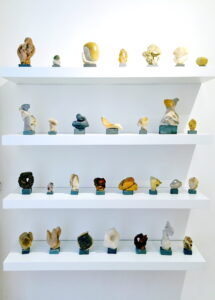
Hasan Hatar, born in Majdal Shams, is rooted in other symbols and his study is committed to the earth and tiny field stones (“Larger than an egg, smaller than a fist”), which he then sorts according to color and substance, assembles and marks using abrasive blasting or engraving, positioning them on a small square basalt rock. The miniature statues, like totems that the hand wants to pet, a fixed into the personal memory and come to represent an act of consolation in light of the high toll taken by the fight over territory. The critique is not directed at those who sell cultural icons, but at the loss of values, the deconstructed conventions, and the hyper-consumption experience used as a fig leaf. It is an opposition to the way in which the symbol has been dishonored in public discourse, and at one and the same time it fixes the breached definitions of high versus low through acts of improvisation, chance and mixture, straight from a Dadaist artisan’s workshop.
Postcard no. 4 (2010) by David Reeb is part of a series of paintings created using photographs of the beach in southern Tel Aviv. The selected gaze, from the Dolphinarium to old Jaffa is not coincidental, as it allows the penetration of aspects hidden from the eyes of those arriving at the beach from the ocean. On an intentionally “bad” painting of a colorful composition, Reeb posits the dark image by screening on the fabric, and the progressive process of the work allows a contemplation of the pastoral appearance and its unmaking. In front of the cross on top of the cathedral, Reeb paints chaos of a yellow moon on the background of a black erasure, a palm tree and a seagull in mid-flight.
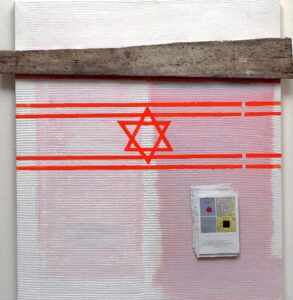
Zuhdi Qadri was born in 1972 in Nahf, a village in the Galilee, studied art in Saint Petersburg, and since his return to Israel in 2004, he is part of an intense dialog with art history, especially the geometric abstract, in a somewhat-embossing painting. The work titled Portrait of a Friend is tri-layered: a pink background, on top of which a geometric image of the star of David and two flag stripes are painted in orange, and wood marking construction materials that are identified with the work of the Arab sector. In addition, some readymade: an invitation to the exhibition of the artist’s friend Ibrahim Nubani, attached to the bottom of the canvas. The orange replacing the typical blue callously undermines the acceptance of the Other, in three situations that are compressed into one canvas and forced, as in real life, to co-exist.
Shlomit Wartenburg, an architect, uses the map of Jaffa as a collection of typologies and outlines that represent the complexity of the place. Mixing media, Wartenburg reweaves, manually, a computerized drawing in a cross stitch technique that creates a pixel effect. The digital image rebuilt in a long process of embroidery is revealed as affirmative therapy.
In Salt and Pepper, the artist Eric Bokobza embraces an unconventional image of the “Bezalel artist”. This is what he would have done, he claims, “had the institution still existed in that framework, and I were a painter there.” Bokobza created an object made of silver filigree and olive tree, two materials typical to the Bezalel artwork of Boris Schatz’s time. Into the eastern motifs such as the cupola and the palm tree, a Trojan horse is introduced in the form of a straight-lined structure, a typical Bauhaus building, a Shaatnez of salt (the salt of the earth, the Ashkenazi, the white) and pepper (the Other, the Mizrachi, the black), which were not melted into one image, but each maintained its own unique character.
-
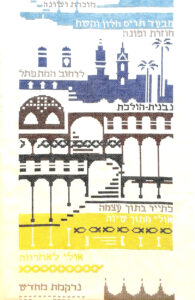
- Shlomit Wartenburg
-
- Reut Frester
-
- Hasan Khater
-
- Zohadi Qadry